

Prediction Is Cheap. Adaptation Is the Moat.
Why long-term advantage comes from how organizations respond when conditions change

By Shelley Holm
This article is part of Forum Solutions’ From Prediction to Adaptation series on AI strategy and enablement as an operating model transformation.
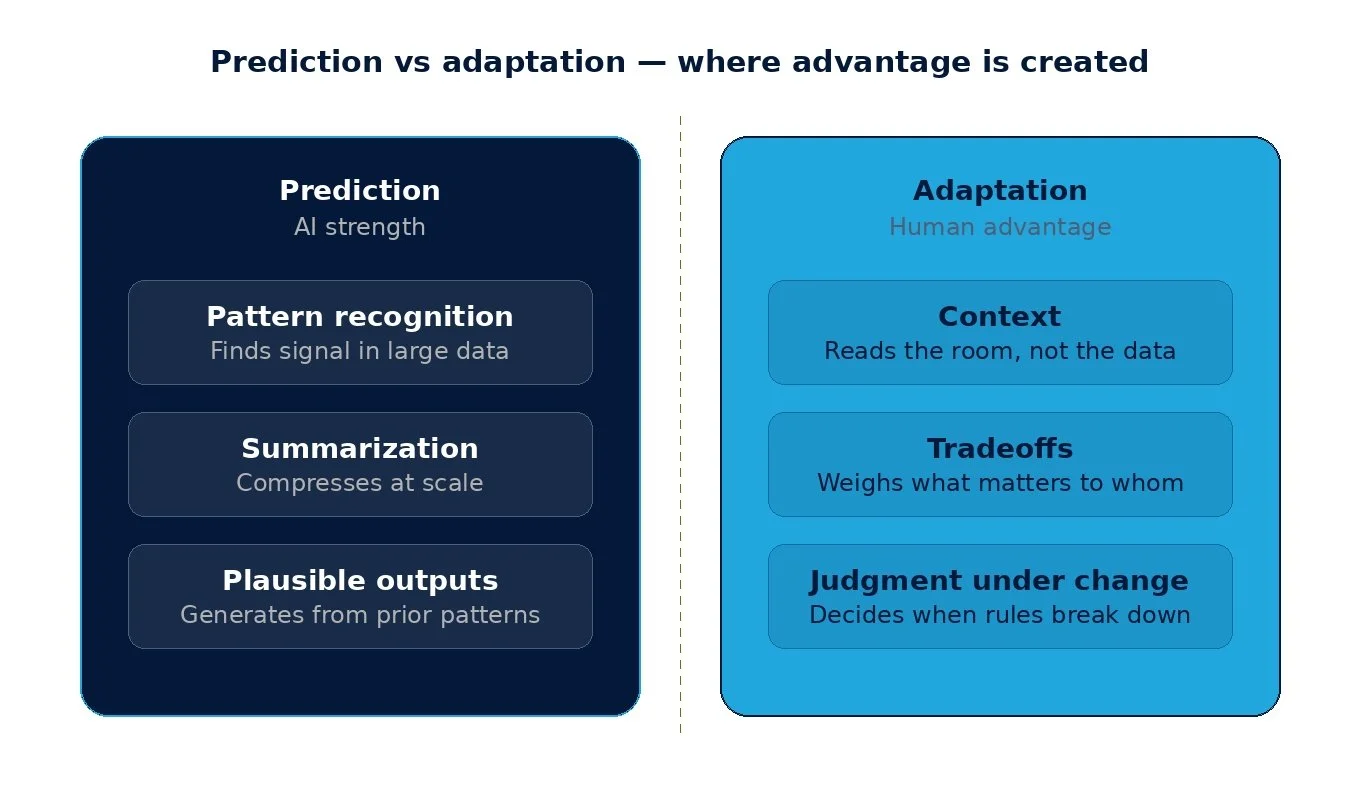
AI will automate some roles, just as previous waves of technology have done. That reality should not be minimized. History also shows that technological shifts eliminate tasks while creating new roles, new capabilities, and new ways of working. AI excels at recognizing patterns and generating plausible next steps. Humans create advantage when those patterns break. That ability to adapt is where organizations truly differentiate and where long‑term value is created.
Key Takeaways:
AI improves prediction and output generation, but it does not create advantage on its own.
Advantage comes from human judgment when context is required and patterns break.
Organizational operating models must be designed so AI accelerates insight and humans drive adaptation.
Generative AI and agents are excellent statistical guessers. They summarize, draft, classify, and propose likely next steps by drawing on patterns they have seen before. But organizations do not operate in a closed pattern library. They function in messy reality, with incomplete information, shifting priorities, competing incentives, and edge cases that resist optimization. In those moments, advantage does not come from producing the most likely answer. It comes from interpreting context and deciding how to respond. [1][2].
Research reinforces what many leaders already observe in practice. Humans outperform AI when environments shift because people reorient and adapt in ways that today’s AI still struggles to match [2][3]. According to McKinsey, nearly three‑quarters of organizations use AI in at least one business function, yet those that treat AI as an input to judgment rather than a substitute for it consistently outperform those that do not. As stakes rise and conditions change, human judgment remains mandatory [1].
Durable advantage in an AI-driven future will not come from better prediction alone. It will come from organizations deliberately designed so AI accelerates insight and humans drive adaptation.
If adaptation is the true source of advantage, leadership choices determine whether that advantage is ever realized. AI expands what organizations can see, decide, and do. Without clear direction, that expansion creates fragmentation rather than learning.
This is where AI strategy becomes inseparable from organizational design, decision rights, and ways of working. The challenge is not access to AI, but focus. Organizations that succeed with AI design operating models that channel expanded tool capability into better decisions, faster learning, and sustained performance.
The next article in the series examines why strategy, prioritization, and governance become essential as AI lowers the cost of action and raises the stakes of decision making.
Forum Solutions works with executives to translate that choice into practice. Through strategy, operating model design, governance, and change enablement, we help organizations move beyond experimentation to sustained impact while protecting the human judgment AI ultimately depends on.
About the Author
Shelley Holm is Co‑Founder and Managing Director at Forum Solutions, where she works with executives to move AI from experimentation to enterprise impact through strategy, operating model redesign, and transformation at scale.
Footnotes
McKinsey & Company, The State of AI in Early 2024: Gen AI Adoption Spikes and Starts to Generate Value
https://www.mckinsey.com/capabilities/quantumblack/our-insights/the-state-of-ai-2024Harvard Business School Working Knowledge, How Humans Outshine AI in Adapting to Change
https://www.library.hbs.edu/working-knowledge/how-humans-outshine-ai-in-adapting-to-changeNature Machine Intelligence (via Neuroscience News), Why Humans Adapt Faster Than AI
https://neurosciencenews.com/human-ai-adaption-neuroscience-29689/