

The Abundance Shift: Reinvest the AI Dividend
Why disciplined AI strategy turns efficiency into a leadership investment decision

By Shelley Holm
This article is part of Forum Solutions’ From Prediction to Adaptation series on AI strategy and enablement as an operating model transformation.
AI does not create abundance on its own. It creates the potential for it, but only when organizations apply clear strategy and disciplined prioritization. Without focus, expanded capability simply accelerates activity. With it, AI begins to generate real capacity.
Most organizations were designed around limits. Time, capacity, and reach shaped how work was planned and how success was measured. AI changes that operating context by expanding what teams can create, decide, and deliver without removing the need for people.
The opportunity with AI is not efficiency alone. It is access to better decisions, faster learning, and opportunities that were previously out of reach.
Key Takeaways:
Usable capacity is the outcome.
Capacity must be reinvested intentionally, or it becomes pressure.
Reinvestment decisions require governance, operating choices, and accountability.
What changes when AI enters the workflow
Evidence shows that AI can unlock meaningful productivity gains in specific contexts, particularly by accelerating learning and distributing best practices. In a large-scale study of more than 5,000 customer support agents, access to a generative AI assistant increased productivity by approximately 14 percent on average. For newer and lower-skilled agents, productivity improved by more than 30 percent, allowing them to perform at levels comparable to more tenured peers. At the same time, highly experienced agents saw limited gains and, in some cases, small declines in quality [1].
The implication is structural. AI compresses learning curves and unlocks latent capacity, but it does not replace deep, situational expertise. As access becomes widespread, advantage no longer comes from having AI. It comes from how leaders invest the capacity AI creates.
From efficiency to reinvestment
AI creates capacity faster than most organizations know how to use it. That creates an abundance problem, not an efficiency one. Scarcity thinking treats time saved as cost to be removed. Abundance thinking treats capacity created as value to be reinvested. The difference matters because efficiency without reinvestment does not create advantage. It creates pressure.
Research reported in Harvard Business Review shows that AI often intensifies work by increasing pace and scope. Without deliberate reinvestment, efficiency turns into cognitive overload and declining decision quality over time [3].
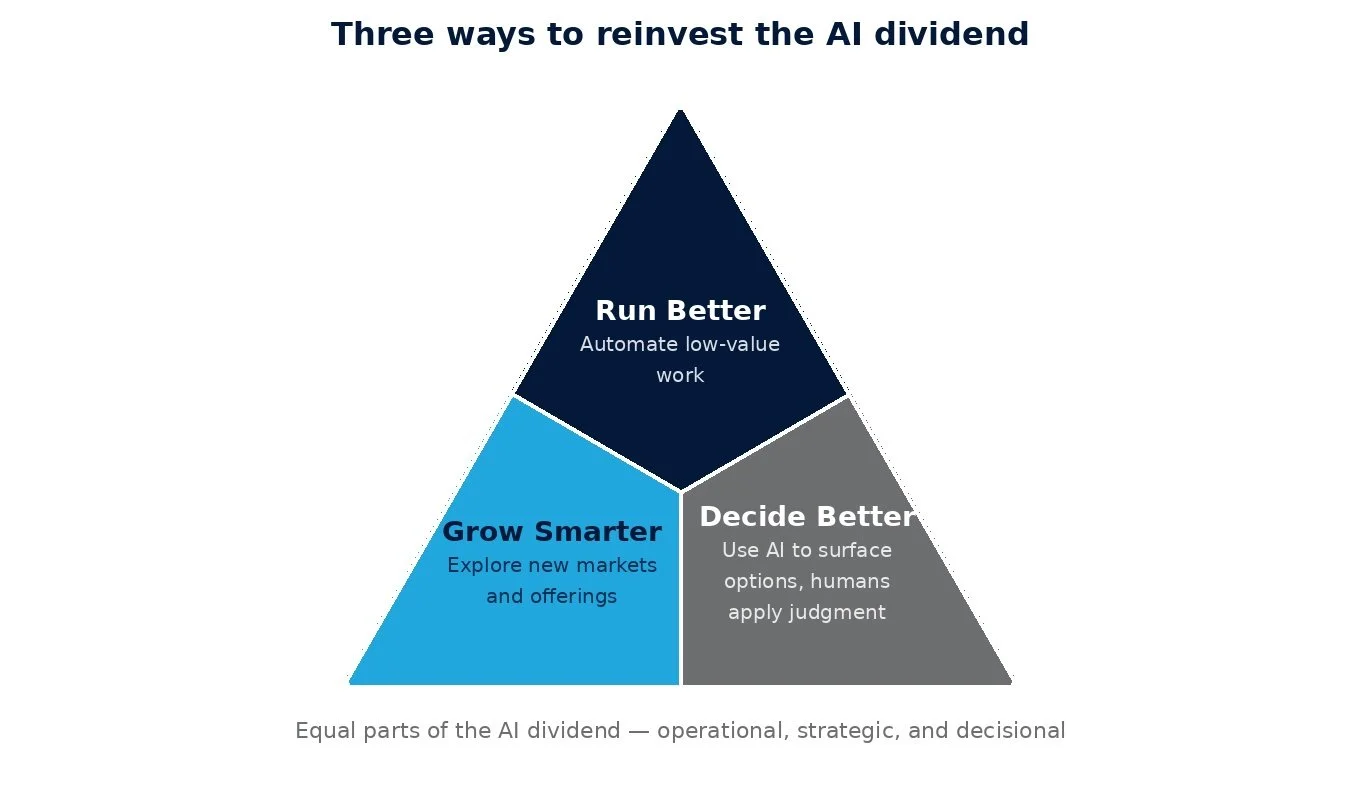
Reinvesting the AI dividend
Abundance does not mean AI does everything. It means human intelligence is no longer consumed by work that does not require it, freeing leaders and teams to focus on growth, creativity, and better decisions [3].
A practical abundance strategy reinvests capacity deliberately:
Run better by automating low-value, repetitive work
Grow smarter by exploring new offerings, markets and models
Decide better by using AI to surface options and scenarios for humans judgment
Reinvesting the AI dividend is a leadership choice, but it cannot remain abstract. Once capacity is created, organizations must decide how that capacity is structured, governed, and sustained. Without clear roles and accountability, abundance introduces new risks alongside new opportunities.
As AI agents move from tools to active participants in the work, leaders are forced to make real organizational choices: who does the work, who makes decisions, who owns outcomes when humans and machines collaborate. That is not a technology problem. It is an organizational design decision.
The next article in this series examines how organizations translate reinvestment into operating reality by defining how humans and AI agents work together at scale.
About Forum Solutions
Forum Solutions works with executives to translate that choice into practice. Through strategy, operating model design, governance, and change enablement, we help organizations move beyond experimentation to sustained impact while protecting the human judgment AI ultimately depends on.
About the Author
Shelley Holm is Co‑Founder and Managing Director at Forum Solutions, where she works with executives to move AI from experimentation to enterprise impact through strategy, operating model redesign, and transformation at scale.
Footnotes
Brynjolfsson, Erik; Li, Danielle; Raymond, Lindsey. Generative AI at Work.
National Bureau of Economic Research Working Paper No. 31161
https://www.nber.org/papers/w31161McKinsey & Company, The State of AI in Early 2024
https://www.mckinsey.com/capabilities/quantumblack/our-insights/the-state-of-ai-2024Harvard Business Review, AI Doesn’t Reduce Work — It Intensifies It (February 2026)
https://hbr.org/2026/02/ai-doesnt-reduce-work-it-intensifies-it